Announcement of upcoming posts and scientific paper, where I will post and publish important features of the planet distribution.
I hope to start a pattern of posting
results while working to a paper, rather than hiding intermediate results until
everything comes out in a scientific paper. I invite others to collaborate with
me on publishing these results: There are enough patterns in the exoplanet
distribution for many first author papers. I will be posting new results on a
spike in the distribution of multiple planets, new details of how the
double-peak and gap feature previously posted about is actually two gaps
separated by a small pileup, new ways of proving that the gap is real, new
insights into the iron abundance-eccentricity correlation likely being valid at
most periods, and I will show how the iron-poor spike feature relates to the
rise and fall of eccentricities of orbits of iron-poor stars.
First, I am posting a rough statement
of purpose: To challenge the science community to make certain that paths are
available to junior scientists to continue in science and not be shut out. I
challenge the science community to assist me in reversing being excluded from
LCOGT photometry by reversing having presented as peer reviewed publications
many papers that do not credit me being included on a single paper. This happened
after LCOGT reneged on my appointment very early despite my excellent record of
performance. I declare the claims that these papers have been peer reviewed to
be false, based on the necessity of including all author-level contributors in
the peer review process. By excluding my participation in the author review of
these papers using false claims that I did not contribute intellectually, I
have been left unable to obtain the employment necessary to reasonably
participate in exoplanet astronomy, and have been wrongfully kept out of
science as a result.
I show my results for which I am first
finding so many features in the next few days for the purpose of showing that I
the type of scientist that the science community must keep involved in science,
by keeping me as a member of collaborations such as Kepler and TESS. I have
sought to be in exoplanet research since 1992 but had struggled to change
fields from nuclear physics to exoplanet research, so I was thrilled that at
LCOGT to start our exoplanet research program in 2005 because it meant that I
was fully involved in exoplanet research. I was doing the exoplanet transit
observations to prepare to be a part of the Kepler project from the start of
the Kepler mission. When my appointment was reneged on in 2007, I made it as
clear as humanly possible that I was in no way willing to leave being a part of
the LCOGT group preparing for Kepler. All supposed indications of me being
willing to leave were made under extraordinary duress.
Due to my need to focus on the paper,
the following is not yet polished:
I am doing my best to contribute to the new statement on ethics being
created by the AAS to stress that ethical procedures must give recourse.
Purposes:
- Participation in exoplanet research, which I have been seeking since 1992
- Promote ethics requiring keeping the path open for every scientist and not blocking anyone.
- Define peer review to necessarily include ``author peer review'', with no manipulation of author-list data allowed any more than manipulation of any other data.
- Require standards of inclusion of contributing persons, by ending allowing moving contributors out of papers by keeping them from working, especially by hostile means including shutting down computer accounts and hampering communication with collaborators.
- Expect all scientists and groups to support ``Going around ostracizing groups’’ by colleagues with better affiliations: All scientists must help if they find out that a collaborating organization has obstructed someone who has been one of its members from participating in the collaboration, by providing alternate access to data and communication. Data must not be accepted from subgroups from organizations keeping out someone who should be included as a member.
- Reject denying credit by journals using fabricated excuses such as false claims that no intellectual contributions have been made, especially when fabrications include interrupting work to minimize further contributions and allowing no discussion of how contributions were intellectual work. Project planning is in fact intellectual work, even more so when doing support work of projects you have been heavily involved in planning.
- Establish ethical guidelines that oppose territoriality especially when stealing others’ contributions by moving out good people.
I present my struggle
to write the papers alone in the absence of these ethics. It has required that I start my learning over, having to learn the planet distribution without the benefit of having finished learning photometry in 2007. I wish it had been as easy as jumping to this new subject, but it took years of searching with false starts learning several new areas before I found this area. For presenting these distributions, I had to learn how to give the proof required to
show these are real. I tried publishing these results on the double peak and gap in 2013, after trying to publish the eccentricity-iron abundance correlation, but without support or colleagues was unable to obtain the fully desired
peer review. I am willing to show how this demonstrates that the science community
cannot keep out someone who is due staying in the group. It would have been far better for these results to have been shared in my groups in 2013, instead it
is 2016 and most scientists have never heard of these features.
I am presenting this as part of seeking collaborators to work on the planet distribution, as well as seeking support from those who should have been my collaborators doing photometry for putting me back on papers I did not want to be kept off of.
I seek to return to being a part of UCSB like every other LCOGT scientist, but seek support of my participation from institutions such as the University of Hawaii that are involved with the global network that is LCOGT but that have not been as complicit as UCSB in obstructing my participation. I am proud to have sought to have been a part of TESS and Kepler missions from their beginning, taking the chance long before missions started.
My passion really is: To do astronomy with other people. I have not wanted to make these discoveries alone.
Preview of results
to be posted in next few days:
I give here a preview of my results being prepared to be published in a
scientific paper, in an effort to attract collaborators given how I have been
made to work alone even though I am a very social scientist. I have presented
many of these features in many conferences, seeking out collaborators whenever
possible. I am finding it hard for scientists to break out of the system and
work with someone who does not have an institutional affiliation, but I am also
finding it hard to fulfill all of the expectations of writing a scientific
paper when I have not been given the same chance as astronomers in normal
institutions to finish my appointment such that I can keep my relationships
with collaborators after changing institutions. I use this preview presentation
of some very important results to make an appeal to the astronomy community to
help me find new ways to properly finish my appointment at LCOGT after that
observatory reneged on finishing my appointment in a manner intentionally
designed to make it difficult for me to continue as an astronomer. Here I
explain my motivations in trying to stay in astronomy even after being declared
persona non grata by LCOGT even though I had over 8 months left on my
assignment at the telescope in Maui, Hawaii followed by an expected return to
join the main group in California. I present these results in a campaign to
attract other exoplanet astronomers to support me being their collaborator.
New Features in the Exoplanet Distribution:
I am now preparing to present features in both a scientific publication
and on this blog, as part of my goal seeking group participation in finding and
understanding exoplanets. I present a newly discovered feature, the spike in high eccentricity among multiple planets that tracks significantly with iron abundance. This is in addition to the spike in the iron-poor population of the full sample of RV planets.
Still to come are full defense of how these features are neither the
result of random chance or from observational effects. Those are necessary for
a scientific paper to be
approved by the peer review arranged by the scientific journal.
These are the features I will be presenting soon:
- Double peak and gap in the distribution of iron-rich single-star sunlike star single-planet distribution
- Gap and longer period peak still present in the distribution of iron-rich single-star sunlike star multiple-planet distribution, but the shorter period peak is either moved or smaller if there at all.
- Two spikes in eccentricity, including the gradual spreading of the spike with iron-abundances gradually going above solar.
- Eccentricity metallicity correlation, including gradual change rather than just being two populations
I have found these features in the distribution of planets found by radial velocity (RV). In all figures, I show only ``objects'' found by RV, where I use ``object'' as a collective term for the parameters of planets, their stars, and their orbit. Unless I specific I am referring to more stars, I am commonly studying a selection (cut) of stars to be ``sunlike'' by having temperatures between 4500 and 6500 K, having a surface gravity acceleration of more than 10^4.0 cm/sec^2 which is written as ``log g>4.0,'' and also to not have a stellar companion. These temperature and gravity cuts are to remove stars further along in their evolutionary sequence. Binary stars often ``excite'' the eccentricity of planets, and indeed in 2013 I found that orbits of planets of stars with stellar companions do indeed have higher mean eccentricities than orbits of stars not to have found to have companions -- a result that evidences that observers have in fact done a good job of finding at least the larger stellar companions that are likely to make a difference. (I do not cut out low or high mass stars which I may do in the future because of how the long period peak of low mass stars is at a lower period).
 |
| The distribution of periods of planets of single sunlike stars, with those of iron-rich stars shown in red (not filled) and those of iron-poor stars in blue (filled), shows a gap from periods of 494 to 923 days, with a deep gap of zero planets from 656 to 923 day periods. |
 |
| Comparing this histogram of counting periods of all planets found by radial velocity (RV) shows that there are 67 periods in the wide gap and 31 in the deep gap. A comparison of the parameters of these ``objects'' (planets+stars+orbits) with the neighboring regions shows the chance that the gap is either random or observational to be less than one in a million. |
 |
| This histogram of the single planet population, selected from the above population of sunlike single star planets, shows that the double peaks and gap are strong features of periods of ``loner'' planets that are not found to be in multiple planet systems. We further see that there is a shorter period gap of zero planets as well as the wider longer period gap. Separating these two gaps are just two planets in this distribution, but they align well with planets in the multiple period distribution suggesting that this pileup could be real rather than just that the small number of periods between the peaks are nearby. |
 |
| This histogram of the multiple planet population, again selected from the above population of sunlike single star planets, shows that the longer period peak and the deep gap are strong features of periods of multiple planets, but the shorter period peak may not be. The shorter period gap and small pileup separating the two gaps may also be a feature of this pileup, but because it does not quite align with the bins, one member of that pileup falls in the bin of the more narrow gap. That one period is at the longer period edge of that bin. These bins were aligned to show the dramatic jump from zero planets in the gap to an abrupt long period peak. |
My next blog post will be to present a new feature, the spike in high
eccentricity among multiple planets in the 10 to 100 day period that tracks
significantly with iron abundance. It is amazing how well the eccentricities of
multiple planets in the 10 to 100 day period range track with iron abundance.
This is in addition to the spike in the iron-poor population of the full sample
of RV planets.
By
causing me to struggle to write papers on the distribution alone, I was delayed
learning how it is necessary give the proof required to show these are real. I
published to the astro-ph arxiv prepreint server my results in 2013 but working
alone was not able to write clearly enough on this new subject fully desired
peer review. It is unreasonable for the community to expect to deny me sought
after involvement with the community and then expect me while home alone to
come up with a clearly written paper satisfying the statistical expectations
that are normally desired. There is good reason for such discoveries to be
supported by good writing, but the community must do better to not so badly
handicap someone from being able to meet these standards. I am willing to make
this a public example to show how this demonstrates that the science community
cannot keep out someone who is due staying in the group. It would have been
better for these results to have been shared in my groups in 2013, instead it
is 2016 and most scientists have never heard of these features.
 |
| A new ``spike'' in eccentricity is presented in this plot of orbits of planets in multiple planet systems hosted by sunlike stars. Not only are all five of the 20 objects in between periods of 10 and 100 days with eccentricities greater than 0.21 in a narrow period range, the iron abundances of the five as a group are much higher than the iron abundances of the fifteen stars having planets with orbits of 0.21 or less. Here, orbits of stars more iron abundant than the sun (``iron-rich'') are identified with red open circles, and orbits of stars with less iron abundances than the sun (``iron-poor'') are identified with blue filled circles. All five high eccentricity objects in the spike are iron-rich, but only seven of the fifteen low eccentricity objects are iron-rich. |
 |
| The same plot as above but this time the boundary between iron rich and poor is set at 1.23 times the iron abundance of the sun, where 1.23 is from how the iron abundance is given as a logarithmic value, and the boundary here is 10^0.09=1.23. In astronomer's jargon, this is [Fe/H] = 0.09. Every single one of the 15 low eccentricity objects has iron below [Fe/H] = 0.09 (below 10^0.09), but only one of the 15 high eccentricity objects has less iron in the star. |
I hope my results demonstrate how much better it would have been for the
community to have helped me stay in the group. I hope that the community will
help me be able to qualify for grants and employment to end my years of
unemployment.
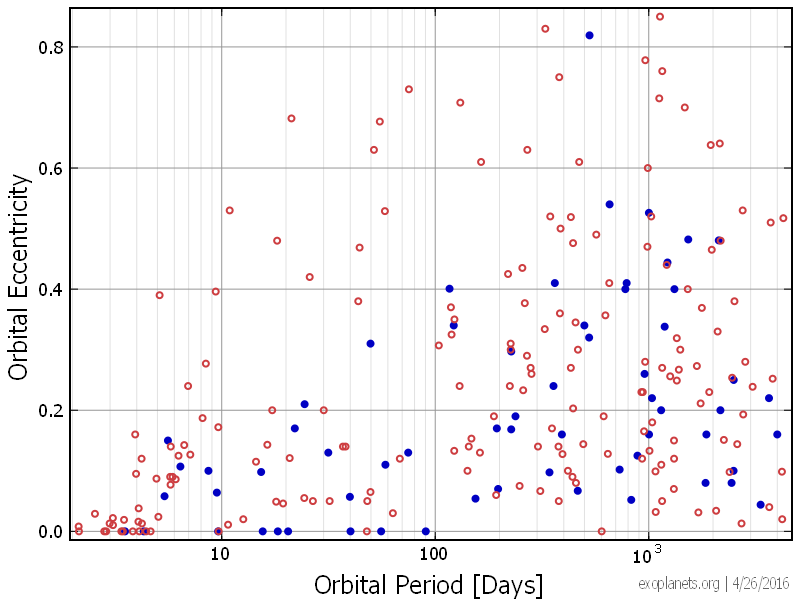 |
| For orbits of sunlike single stars, this eccentricity as a function of period even looks to the eye that beyond the shortest periods, where orbits are circularized to lower eccentricities by tidal interaction with the star, that the eccentricities of orbits of stars more iron abundant than the sun (``iron-rich,'' red open circles) are higher at most all periods than the eccentricities of orbits of stars less iron abundant than the sun (` `iron-poor,'' blue filled circles). The exception may be in the region of the gap in counts of iron-rich orbits, from periods of 494 to 923 days. That region not only has low eccentricity orbits of iron-rich stars, it has small number of high eccentricity orbits of iron-poor stars that might not have a significant of objects here, were it not for how there are more such ``high eccentricity iron-poor objects'' in the larger population (where I use the term ``object'' to mean the parameters of the planet, star, and their orbit collectively). |
 |
| Here, the eccentricities versus periods of all stars are shown there are seven orbits of iron-poor stars that have eccentricities of above 0.55, and six of these seven are within a narrow period range that corresponds to the shorter period side of the gap found above. Even the eccentricities of the orbits of iron-rich stars in this gap region (494 to 923 day periods) have lower eccentricities that outside this region. |
 |
| Here again the eccentricities versus periods of all stars are shown but the dividing iron-abundance has been raised to 10^0.1 or 1.26 times that of the sun, which is written as [Fe/H]=0.1. The way that this spike widens to include more nearby shorter period stars adds evidence that this spike is real feature that changes gradually, In fact, it can start to be seen that there is a gradual change in eccentricity with iron abundance at most periods shorter than this spike (shorter than 500 days). That is, there are not really two distinct populations of iron-poor and rich stars that suddenly change. At longer periods, the story may be more complicated, but at the longest periods there does appear likely to be higher eccentricity orbits of more iron-rich stars but further work and possibly more data are needed to be sure. |
I briefly mention what the recourse must be in cases where someone is
bullied out of a group: That organization must enable the wrongly expelled
scientist to have both a separate position of safety combined with the option
of returning to the original group. Victims must be given two affiliations,
with the cost of supporting two affiliations being an appropriate deterrent to
organizations bullying people out of being a group member. I challenge the
science community to support this requirement by including it in rules for
eligibility for government grants. Until this reasonable requirement is
established, collaborators must make it possible for ostracized scientists to
not be ostracized from their larger collaborations as well, by providing data
access and communication that go around the barriers that a bullying
organization such as LCOGT might create to keep out randomly undesired
scientists.
Conclusions
My expectation is that scientists can to participate such that they can finish they work, and that they cannot be randomly stopped by superiors without good reason. I insist that the community make it possible for me to continue contributing and learning from where I unwillingly left off. I just wanted to keep doing science. Let's work together. Stop keeping me out, and let me back in.
I challenge the science community: Make participation possible!
Appendices to post.
I apologize that this post is a bit rough and will need to be revised,
but I must get back to writing the exoplanet distribution paper.
Appendix to post: Comments explaining why ``peer review’’ must be
defined to include the review of all relevant scientists, and comments on
having previously issued a public request for astronomers to ``Go around the observatory’’
by enabling me to be a part of group research by setting up alternate access to
LCOGT data and communication with groups to get around LCOGT ostracizing me:
I am proud of starting a program that has delivered our data towards
confirmation of many planets. I hope that it is worth having these papers
published with the full peer review of all the contributing authors that they
publish the first complete-author versions of these papers with me, rather than
trying to pass off as peer reviewed the versions printed without the first
astronomer actually at the LCOGT telescopes. I ask that they support the
expectation of every astronomer who goes to work at the telescope for a project
that the astronomer will have full opportunity to participate in the
intellectual use of that data, and that no paper be called ``published’’ until
the group of authors give full chance to intellectual participate to every
contributor who does everything possible to stay involved. I hope that my
intellectual work on the distribution puts an end to the question of whether I
have been intellectually involve in these works. I expect the science community
to require these authors to stop keeping me out by saying that those papers
that I have been kept off of cannot be considered to be peer reviewed papers
until they are resubmitted with consultation with me. This would be my first
chance to finish my intellectual contributions to them. I look forward to
joining my co-author colleagues in publishing the first LCOGT papers that can
confidently be said to have been fully peer reviewed. In 2013, I posted on the
astro-ph “arxiv” pre-print service my request to collaborators to help me “Go
around the observatory” (http://arxiv.org/pdf/1309.3283.pdf ). I ask that all
collaborators of LCOGT recognize that LCOGT has been keeping me out of having
any papers come from my hard work contributing to LCOGT, including contributing
to the intellectual work of project planning. I ask these collaborators to
arrange with me how I can participate in group papers to make sure that they
are not part of using anyone’s work without letting them have a chance to work
with the group.