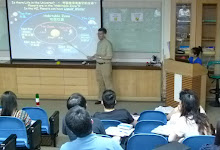
I am grateful to many astronomers and staff in Hilo for accommodating my visit during my unexpected opportunity to visit Hilo. I enjoyed talking to several astronomers at the University of Hawai'i' at Hilo Institute for Astronomy (IfA), the Imilioa Planetarium, and the Subaru Telescope. The staff and astronomers at the Gemini telescope were doing their best but were prevented by a telescope emergency from coming out. I ran out of daytime to visit the submillimeter array and the Keck Observatory was too far away (in Waimea).
The Subaru outreach top scientitst and the outreach astronomer showed the gracious courtesy typical of Japan that clearly is adopted by Americans working there as well. Emily and I were staying at a place where there were more Japanese than any other group, so I couldn't help notice the considerate manner in which Japanese always interact with others. It strongly tends towards being very genuine.
Emily and I greatly enjoyed the happy, culturally rich visit of the Hilo area. The farmers market was the most fun of any I've been to in the U.S. We also enjoyed the natural features of such a volcanic island.
Coming: Pictures of my Hawai'i professional visits, and I'll put some nature photos on facebook.
Wednesday, February 24, 2010


Saturday, February 20, 2010
Honolulu Talks and visits with astronomers and public
Had a wonderful time in Honolulu visiting the Institute of Astronomy of the University of Hawaii at Manoa, and visiting the Bishop Museum Planetarium. I talked at the planetarium on planet destruction, life in the universe, and the meaning of astronomy for humanity. I displayed my campaign to return to astronomy. I appreciate my parents for providing an opportunity to take my efforts to the most difficult state to reach that is so very important to astronomy.
The audience was a good active group with many good questions. The museum has some very nice displays, including their "science in the sphere." I enjoyed talking with the three staff members/volunteers who came that night to run the talk.
I took some good photographs of the visit and hope next week to post them.
I also presented my professional research talk to several astronomers at UH IfA. We had some good discussions particularly regarding what may happen with protoplanet destruction, and what these events might allow astronomers to learn.
The audience was a good active group with many good questions. The museum has some very nice displays, including their "science in the sphere." I enjoyed talking with the three staff members/volunteers who came that night to run the talk.
I took some good photographs of the visit and hope next week to post them.
I also presented my professional research talk to several astronomers at UH IfA. We had some good discussions particularly regarding what may happen with protoplanet destruction, and what these events might allow astronomers to learn.
Saturday, February 13, 2010
Scientific Talk at Arizona State University, in sunny Phoenix
Just got back from an enjoyable visit to Arizona State University, where I again talked about how planet destruction may be observable. I still am talking about the most luminous events, from the most massive planets, but I talked more about the likely less rare events of smaller planets and even protoplanets spiraling in to Roche lobe overflow (as opposed to encountering the photosphere as the largest planets will).
I appreciate Steven Desche for hosting me. I also got some good information from several faculty, and will be better able to incorporate the earlier work of Sumner Starrfield, who long ago studied what happens when material from a stellar companion accretes onto a star (or falls onto a star).
ASU has many interesting projects organized around a university-wide emphasis on interdisciplinary research. I was able to hear a fascinating talk on the mineralogy of Mars from a scientist working on the Spirit rover. He showed how it is not completely stuck and just might get out yet.
Next week: Hawaii.
I will talk about Planet Destruction at the Bishop Museum planetarium in a free public talk.
See
http://www.bishopmuseum.org/calendar/february.html and click on the
lecture on Feb 16
( the text is http://www.bishopmuseum.org/calendar/events/feb16.html )
http://www.bishopmuseum.org/
lecture on Feb 16
( the text is http://www.bishopmuseum.org/
My father is taking my family, all 16 people. It's far more of a fancy thing than he has ever done since he has always been very careful with money, though growing up my parents did a wonderful job of driving us to see much of the U.S.
It will be great talking astronomers with people in the Aloha state!
Presentation at Washington DC American Astronomical Society Conference
I presented my work on observing planet destruction during a visit to Washington DC to attend and speak at the American Astronomical Society conference. I also used my flipbook to get in a 2nd presentation on my transit observation work, starting from my contributions to the TrES-3 discovery paper as LCOGT's astronomer at the telescope (Faulkes Telescope North, or FTN), and I presented my continued efforts to contribute to the global telescope observations of some of the most fascinating transits, including HD 17156 and HD 80606.
There were many exciting developments on planet migration, tidal theory, and transits that were presented.
I am grateful for kind people from couchsurfing.org for stepping in and giving me a place to stay after I have been unable to get new institutional support following the failure of the funder of LCOGT to follow through on expected support. A very kind husband and wife hosted me for two nights, and I especially enjoyed their company in those evenings. Nick is originally from Taiwan, so we shared our memories from there, since I lived in TW for two years. I practiced a little Mandarin, also with Nicolle who is also learning Mandarin.
The other nights were spent at a dorm in the Washington DC HI hostel. Most people were very nice, and I slept well every night except one. Even the worst night was not horrible, but I did wish that the roommates wouldn't continue to dry their hair until nearly midnight.
I am grateful to myself for having been a good saver and my parents who taught me to save. Credit for my support is borrowed against my future. I am grateful for American Airlines and United Airlines having good frequent flier programs where flights can actually be redeemed. A wonderful astronomer in Maryland was also kind to let me stay the night of a wonderful New Year's Eve party. The support of the AAS allowing me to volunteer in place of registration fees cannot be forgotten. I appreciate my wonderful fiancee Emily's continued patience and moral support while I seek to replace the missing publications credit with work done entirely on my own without a salary.
It was very good to interact with other astronomers and to try and regain the sense of professional community when one is a scientist without his papers credit and being kept unemployed.
There were many exciting developments on planet migration, tidal theory, and transits that were presented.
I am grateful for kind people from couchsurfing.org for stepping in and giving me a place to stay after I have been unable to get new institutional support following the failure of the funder of LCOGT to follow through on expected support. A very kind husband and wife hosted me for two nights, and I especially enjoyed their company in those evenings. Nick is originally from Taiwan, so we shared our memories from there, since I lived in TW for two years. I practiced a little Mandarin, also with Nicolle who is also learning Mandarin.
The other nights were spent at a dorm in the Washington DC HI hostel. Most people were very nice, and I slept well every night except one. Even the worst night was not horrible, but I did wish that the roommates wouldn't continue to dry their hair until nearly midnight.
I am grateful to myself for having been a good saver and my parents who taught me to save. Credit for my support is borrowed against my future. I am grateful for American Airlines and United Airlines having good frequent flier programs where flights can actually be redeemed. A wonderful astronomer in Maryland was also kind to let me stay the night of a wonderful New Year's Eve party. The support of the AAS allowing me to volunteer in place of registration fees cannot be forgotten. I appreciate my wonderful fiancee Emily's continued patience and moral support while I seek to replace the missing publications credit with work done entirely on my own without a salary.
It was very good to interact with other astronomers and to try and regain the sense of professional community when one is a scientist without his papers credit and being kept unemployed.
Tuesday, October 27, 2009
Successful Across the Nation Speaking Tour Completed
Late yesterday I drove back to Los Angeles, after three weeks of touring astronomy departments from Tuscon to New England. I am grateful to all those who hosted me and who spoke to me. I appreciate many people letting me present my talk either through my presentation book or though a more formal talk process. It is necessary for a scientist to get feedback, and I am grateful to all who gave feedback. I am especially grateful for the patience of those astronomers who understand that I have not had the normal professional interchange due to being sent home in a manner that has denied me the normal collegial sociality that scientists expect.
I am continuing to job search, even considering a return to graduate school arrangement. My next new effort will be to speak publicly about my mission to be an astronomer who has my career, family, and friends. Family means marriage and children, so I could this as four goals. I will openly claim my history and future: to not let someone powerful have the final say on my four goals of career, friends, or how I seek marriage and children. I choose to publicly seek these four purposes of life: perhaps I will get them, or perhaps not, but either way, I would rather people know how employment in science affects obtaining these most important things in life.
Onward for having career, family, and friends!
Monday, October 19, 2009
Driving to Utah to see family
It has been too long since I have seen my family in Utah, and now my father is very ill. I have never driven to see my family from such a long distance. The situation I have been put in has been a difficulty on my entire family. I had always expected to be a scientist who gets married and has children. I should have been lucky because nature has been kind to me, giving me no reason as far as I know that I couldn't have had family by now. But people put other plans instead. I was moved out of science to the extent of having my data access blocked, with colleagues and friends blocked from me by someone's choice. When I pointed out how this would end my life goal of career, I was told this was better for me. This was called "help" from someone who claimed he was giving me personal direction as a friend. If I lost my goals due to natural causes, it has to be accepted that things happen by nature without regards to our choices. But it is necessary to oppose unethical harm done by choice. Nature cannot be negotiated with. But we must expect people in power to follow principles of ethics to not do unnecessary harm. People can be pushed to make better choices.
I insist on going forth with my goals, to have the obstacles intentionally put in front on me replaced by help:
Career, family, and friends.
Saturday, October 17, 2009
Talk at Pennsylvania State
The astronomers at Penn State kindly hosted me at their snowy campus in State College. I was preceded by another very good exoplanet talk. Their was a very enthusiastic discussion, largely on what might be expected to happen that might or might not allow the energy signature of planet destruction to be seen.
Before and after the talk, I had good discussions with several astronomers. PSU has put together quite a good exoplanet group, following the lead of Professor Alex Wolszczan who made the first firm discovery of planets outside the solar system in 1992, three years prior to the discover of 51 Peg. I've talked with Professor Wolszczan in the past, which was good since he was on travel but most of the other PSU exoplanet astronomers were there.
I also took some photos of the campus with the bright colors of autumn leaves mixed with all the unusual early snow. I also enjoyed this scenery on the drive from State College to Youngstown, Ohio.
Subscribe to:
Posts (Atom)