Wednesday, August 5, 2015
Outdoor Poster Presentation
I am now showing giving the "Outdoor Poster Presentation" with my full science poster printed and laminated so I can carry it. Here is the slightly updated printed version:


Missing Planets! The Participation Gap
 |
| Credit to a conference attendee |
I am looking a little at the other
stars, the “trash”, and am already seeing them to be “one
(wo)man's trans is another's treasure.” In 2013 I found an
exception to the newly discovered trend of higher eccentricity among
planets hosted by iron-rich stars.
It was my 2012/2013 discovery of that
“eccentricity-iron” correlation, also found independently (at
close to the same time) by two others (Dawson and Murray-Clay, 2013),
that shifted me to study patterns in planets at all periods. Before
then, I have been primarily paying attention to the populations of
planets closest to the star, following the line of looking at planets
going into stars, or “planet destruction.”
Now, I will go pick up a laminated
version of my poster, to continue my “outside poster session.” Laminated, because a typhoon is coming, and yes I will present my poster in the rain!
Cheer me on, and please share this blog
with as many friends as you can!
Astronomers: If you see me, can we take pictures
together? Thanks to all those who have taken pictures!
How does it feel to be kept outside?

How does it feel to be left out? Take a
look at these pictures by an astronomer kept out of science by other
scientists. These pictures are of me being kept outside the
conference,” doing a campaign to get the support to be in the
conference.
 I am looking for sponsors who could
make the difference in whether I can do science, or if I'll have to
give in and do desperation jobs that don't support doing research.
There are prizes with big money, given to scientists who have already
been paid well, raised by the big societies and other
philanthropists. How about rewarding a scientist who will be forced
to quit if no one sponsors him? My goal of presenting my work outside
at the door is to get enough notice to attract sponsors: people who
will crowd-fund me. I am not expecting the fellow astronomers walking
in the door to contribute the big amounts that it takes (though every
little couple-dollar donation builds momentum) but I am asking
astronomers and people on the street to share this blog, and the link
to my Indiegogo campaign.
I am looking for sponsors who could
make the difference in whether I can do science, or if I'll have to
give in and do desperation jobs that don't support doing research.
There are prizes with big money, given to scientists who have already
been paid well, raised by the big societies and other
philanthropists. How about rewarding a scientist who will be forced
to quit if no one sponsors him? My goal of presenting my work outside
at the door is to get enough notice to attract sponsors: people who
will crowd-fund me. I am not expecting the fellow astronomers walking
in the door to contribute the big amounts that it takes (though every
little couple-dollar donation builds momentum) but I am asking
astronomers and people on the street to share this blog, and the link
to my Indiegogo campaign. I started my campaign on Day 1 of the
IAU conference with a begging to not be kept out, asking astronomers
to use social media to “share” my blog.
I started my campaign on Day 1 of the
IAU conference with a begging to not be kept out, asking astronomers
to use social media to “share” my blog.
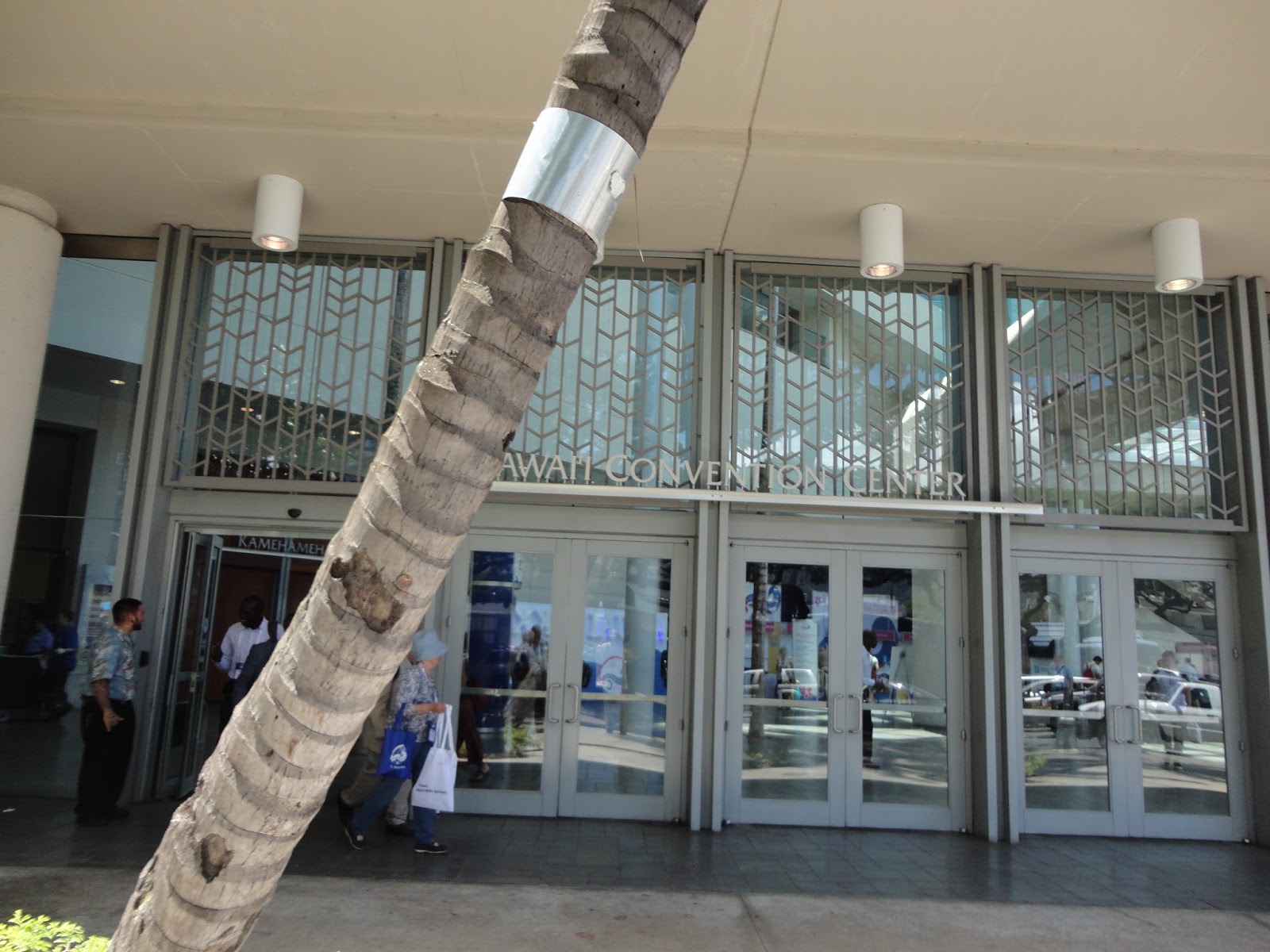
As I was campaigning, these pictures of
myself reflected in the glass in front of the conference logo, and
another in front of the registration desk, presented themselves to
me. The pictures of me reflected on the outside with other
astronomers on the inside illustrates one person being kept out by
the group.
I must remark that having to do this is
also an illustration that circumstances are too hard in astronomy,
not just for me but for many others. I am of course not the only one
struggling – many others tell me of having to “use their own
money” though so far no one has said they're using their own money
while not making any money for a long time. I hope these pictures
will provoke some careful discussion of the situation of American
science.
Pardon that I post twice as once, but "Belonging" and my science of "Missing Planets" are two subjects each deserving one post.


Monday, August 3, 2015
In Honolulu to start "Battle for Belonging" Campaign by going to IAU meeting missing reneged on support
I've made it to Honolulu where the IAU meeting starts tomorrow. I have a great presentation all ready to go. But I'll have to present my work on the street, until I get enough people to contribute to my campaign through Indiegogo Life, at https://life.indiegogo.com/
I will be blogging about:
1. An upbeat part, why I am coming: I have great results, and
2. A challenged part, why I am going to have to stand outside the door, begging for the support necessary to go in.
My upbeat part is the discovery of a gap in the occurrence distribution of giant planets hosted by stars more iron-rich than the sun ("iron-rich" systems) that does not occur in the iron-poor system planets (where I emphasize I only refer to the iron abundance of the host stars, not of the planets, which we don't know very well yet). I published finding this gap in 2013, but only now fully present that if you cut out the systems with stellar binary companions, and cut out systems with too low of gravity (log g < 4.0) to cut out overly evolved stars (often with too large of a radius) and cut out too cool or too hot of stars, keeping 4500 < T_effective < 6500, then there a gap of zero iron-rich system planets between periods of approximately 653 and 923 days. Here is the poster. I hope I get to present it as a poster, rather than having to chop it up into pages to put into a flip chart, but if that is what it takes to present, I'll do that. Here is the poster -- but since I see it shows too small, so in the next few days, I'll stretch it out and write about what it says in this blog, as part of the process of producing a full scientific paper on it.

These results are going to have to be presented "outside the door" on the street, because of an observatory reneging on my appointment for funny reasons -- reasons that would never happen anywhere else in astronomy, anywhere with standards. Because I was stopped from finishing the projects I started by the observatory keeping data away from me and telling no one to talk to me, I have not been able to get any new job that will give standard support for me to go to the IAU conference. So I have spent (loaned my campaign) some of the last money I have for airfare and the first few days lodging, to go and beg for the support to get in, and pay myself back for travel and living expenses.
So I am coming to the door of the IAU conference with a sign begging for some few people who love science to rather than contribute to a big science project or to a prize for a scientist who already had a good salary, to contribute to a scientist with good results but who was pushed out of science by being pushed out of his good projects, which were taken away and given to new hires by LCOGT. I of course am also pressuring LCOGT to take back its responsibility of the reneged on year appointment and the loss of having promised support to finish the research necessary for me to have gotten a new job. I am showing the grant givers (NSF, NASA, etc.), telescope lease site holders, and importantly, collaborators who could put me back into collaborations that I've been forced out of by finding ways to include me in producing our group's papers.
I've got the poster board and pens to make the signs. Please support me my sharing my campaign on social media and anywhere else it might attract attention not just from people, but from the regular media as well.
As I always say when I start comedy performances, "Hot balls of gas!" because stars are all hot balls of gas. Wish me success by sharing, sharing, sharing!
Stuart
I will be blogging about:
1. An upbeat part, why I am coming: I have great results, and
2. A challenged part, why I am going to have to stand outside the door, begging for the support necessary to go in.
My upbeat part is the discovery of a gap in the occurrence distribution of giant planets hosted by stars more iron-rich than the sun ("iron-rich" systems) that does not occur in the iron-poor system planets (where I emphasize I only refer to the iron abundance of the host stars, not of the planets, which we don't know very well yet). I published finding this gap in 2013, but only now fully present that if you cut out the systems with stellar binary companions, and cut out systems with too low of gravity (log g < 4.0) to cut out overly evolved stars (often with too large of a radius) and cut out too cool or too hot of stars, keeping 4500 < T_effective < 6500, then there a gap of zero iron-rich system planets between periods of approximately 653 and 923 days. Here is the poster. I hope I get to present it as a poster, rather than having to chop it up into pages to put into a flip chart, but if that is what it takes to present, I'll do that. Here is the poster -- but since I see it shows too small, so in the next few days, I'll stretch it out and write about what it says in this blog, as part of the process of producing a full scientific paper on it.

These results are going to have to be presented "outside the door" on the street, because of an observatory reneging on my appointment for funny reasons -- reasons that would never happen anywhere else in astronomy, anywhere with standards. Because I was stopped from finishing the projects I started by the observatory keeping data away from me and telling no one to talk to me, I have not been able to get any new job that will give standard support for me to go to the IAU conference. So I have spent (loaned my campaign) some of the last money I have for airfare and the first few days lodging, to go and beg for the support to get in, and pay myself back for travel and living expenses.
So I am coming to the door of the IAU conference with a sign begging for some few people who love science to rather than contribute to a big science project or to a prize for a scientist who already had a good salary, to contribute to a scientist with good results but who was pushed out of science by being pushed out of his good projects, which were taken away and given to new hires by LCOGT. I of course am also pressuring LCOGT to take back its responsibility of the reneged on year appointment and the loss of having promised support to finish the research necessary for me to have gotten a new job. I am showing the grant givers (NSF, NASA, etc.), telescope lease site holders, and importantly, collaborators who could put me back into collaborations that I've been forced out of by finding ways to include me in producing our group's papers.
I've got the poster board and pens to make the signs. Please support me my sharing my campaign on social media and anywhere else it might attract attention not just from people, but from the regular media as well.
As I always say when I start comedy performances, "Hot balls of gas!" because stars are all hot balls of gas. Wish me success by sharing, sharing, sharing!
Stuart
Saturday, November 29, 2014
The "Campaign for Participation" moving to a "Battle for Belonging"!
I am submitting this to post on the blog of the Center for Women in Astronomy (yes, many male astronomers do post there):
Nothing shakes your sense of belonging more than being given the stron message that no one wants to talk with you ... unless it's being made to feel you cannot join any new group.
I am preparing a crowdfunding campaign to produce a documentary studying ostracism in astronomy, and I need help reviewing the draft pitch for crowdfunding.
Issues of retaliation and ostracism are important to members of the astronomy community who are concerned with issues that can stop scientists from pursuing science. Ostracism and retaliation can affect men and women, and can be ruinous to being in science, regardless of whether it comes from discrimination or from ``we just don't like you.''
Many of issues of concern cannot be adequately addressed if the community goes along with retaliation for reporting harrassive or discriminatory behavior.
No member of the community can be ostracized for reporting issues related to abuse or discrimination of any kind.
A documentary on ostracism will be able to show how ostracism and retaliation lead to imposter syndrome, the subject of an upcoming session at the AAS meeting. A full discussion of imposter syndrome must include a discussion of how imposter syndrome is likely to be felt by a target of
ostracism or retaliation, especially the ostracized job searcher, who might be called an ``imposter'' job applicant due to having to cover up disruption of previous research. The fear of ostracism would certainly be a major driver of feeling inadequate. It is also essential to this discussion to consider the effect on the skills development of a target of ostracism. How can a target of ostracism job search not feel like a terrible imposter, when a person's group
has thrown him or her out and intentionally blocked any more skills development or paper credits?
I ask for the community's support to help me crowdfund by first helping with the writing, and then helping spread publicity of this documentary once the crowdfunding site is launched.
(I do not seek contributions from astronomers here, since astronomers are not rich, but rather need help getting support from the larger community
that loves astronomy.)
Please leave comments of how to improve my pitch here:
https://www.kickstarter.com/projects/1807739139/1899930498?token=be35c64f
I seek to participate in the discussion on imposter syndrome at the next AAS meeting, as well as contribute the topics of ostracism and retaliation
for the planned series of sessions on ethical issues.
However, I have been unemployed for many years, and have no way of paying for attending the AAS meeting unless I get support from the public through crowdfunding. I hope to use this documentary and campaign as a means of overcoming the obstructions keeping me out of astronomy.
Belonging and participation are essential values that should have wide appeal in the science community as well as the general public. I am discussing many issues that are covered in AAS ethics statements, but also many essential ethical issues that are left uncovered.
Please leave comments on how to improve my pitch. I need as much support as I can get to overcome opposition to me being in the group, so that I can be a part of the astronomy community.
I hope the community will support my efforts to do a documentary as well as take back my role in research so that I can return to being a productive and supported member of the community. I hope that whatever means I develop to overcome ostracism, retaliation, and imposter syndrome will be of value to future scientists seeking to participate in astronomy!
Nothing shakes your sense of belonging more than being given the stron message that no one wants to talk with you ... unless it's being made to feel you cannot join any new group.
I am preparing a crowdfunding campaign to produce a documentary studying ostracism in astronomy, and I need help reviewing the draft pitch for crowdfunding.
Issues of retaliation and ostracism are important to members of the astronomy community who are concerned with issues that can stop scientists from pursuing science. Ostracism and retaliation can affect men and women, and can be ruinous to being in science, regardless of whether it comes from discrimination or from ``we just don't like you.''
Many of issues of concern cannot be adequately addressed if the community goes along with retaliation for reporting harrassive or discriminatory behavior.
No member of the community can be ostracized for reporting issues related to abuse or discrimination of any kind.
A documentary on ostracism will be able to show how ostracism and retaliation lead to imposter syndrome, the subject of an upcoming session at the AAS meeting. A full discussion of imposter syndrome must include a discussion of how imposter syndrome is likely to be felt by a target of
ostracism or retaliation, especially the ostracized job searcher, who might be called an ``imposter'' job applicant due to having to cover up disruption of previous research. The fear of ostracism would certainly be a major driver of feeling inadequate. It is also essential to this discussion to consider the effect on the skills development of a target of ostracism. How can a target of ostracism job search not feel like a terrible imposter, when a person's group
has thrown him or her out and intentionally blocked any more skills development or paper credits?
I ask for the community's support to help me crowdfund by first helping with the writing, and then helping spread publicity of this documentary once the crowdfunding site is launched.
(I do not seek contributions from astronomers here, since astronomers are not rich, but rather need help getting support from the larger community
that loves astronomy.)
Please leave comments of how to improve my pitch here:
https://www.kickstarter.com/projects/1807739139/1899930498?token=be35c64f
I seek to participate in the discussion on imposter syndrome at the next AAS meeting, as well as contribute the topics of ostracism and retaliation
for the planned series of sessions on ethical issues.
However, I have been unemployed for many years, and have no way of paying for attending the AAS meeting unless I get support from the public through crowdfunding. I hope to use this documentary and campaign as a means of overcoming the obstructions keeping me out of astronomy.
Belonging and participation are essential values that should have wide appeal in the science community as well as the general public. I am discussing many issues that are covered in AAS ethics statements, but also many essential ethical issues that are left uncovered.
Please leave comments on how to improve my pitch. I need as much support as I can get to overcome opposition to me being in the group, so that I can be a part of the astronomy community.
I hope the community will support my efforts to do a documentary as well as take back my role in research so that I can return to being a productive and supported member of the community. I hope that whatever means I develop to overcome ostracism, retaliation, and imposter syndrome will be of value to future scientists seeking to participate in astronomy!
Sunday, October 12, 2014
Come to Hong Kong and Shop Local!
If you travel internationally, or know someone who does, then consider how visiting Hong Kong can help support democracy. You can visit the protests: they are peaceful, pleasant, and a fascinating show of mixing good art into civic participation. It's a once in a lifetime chance to being a part of history.
Hong Kong small businesses need people to support them since China has cut off tour groups to Hong Kong, and the road blockages has meant some people from the outskirts of Hong Kong (such as the New Territories) have avoided coming into Hong Kong's shopping areas. Don't worry, you can take the subway everywhere, even though bus and tram service has been partly obstructed by roads and freeways being used for civic activity instead of vehicle traffic.
Hong Kong is a great place to visit. Many locals speak English, and locals often volunteer to help translate if you do want to buy something from someone who doesn't (Most tourist oriented shops and stands are staffed by English speaking sales staff, but the sweet older lady selling fruit may not). Try the local restaurants and sample the Cantonese cuisine. They'll have someone to help you in English.
Make it a point to come into the city if you have an airline transfer. It's an easy to get around city, with helpful people, cheap taxis, and a great subway. Here's my video to promote my message:
Video Link: Visit Hong Kong and shop local! (http://youtu.be/URC6N3jN8sU)
Come to Hong Kong and shop local!
Hong Kong small businesses need people to support them since China has cut off tour groups to Hong Kong, and the road blockages has meant some people from the outskirts of Hong Kong (such as the New Territories) have avoided coming into Hong Kong's shopping areas. Don't worry, you can take the subway everywhere, even though bus and tram service has been partly obstructed by roads and freeways being used for civic activity instead of vehicle traffic.
Hong Kong is a great place to visit. Many locals speak English, and locals often volunteer to help translate if you do want to buy something from someone who doesn't (Most tourist oriented shops and stands are staffed by English speaking sales staff, but the sweet older lady selling fruit may not). Try the local restaurants and sample the Cantonese cuisine. They'll have someone to help you in English.
Make it a point to come into the city if you have an airline transfer. It's an easy to get around city, with helpful people, cheap taxis, and a great subway. Here's my video to promote my message:
Video Link: Visit Hong Kong and shop local! (http://youtu.be/URC6N3jN8sU)
Come to Hong Kong and shop local!
Thursday, June 5, 2014
Hong Kong Tiananmen Square Anniversary Vigil: Will Hong Kong get "One-person One-Vote"?
The mood was electric yesterday in Hong Kong's Victoria Park, when I joined what must have been the largest energized crowd I had ever been in. There were so many people that it is hard to believe the police estimate of there being 99,500 people present. That number is too suspicious: 500 short of 100,000?
Hong Kongers were energized by more than a crackdown 25 years ago in Beijing: many here want "universal suffrage", or in simpler words, "one-man one vote," for Hong Kong's local rule. Many are worried that the special freedoms granted to Hong Kongers is being challenged by pressure from "the mainland."
So I believe that the organizers estimate of 180,000 people is closer to the mark. Regardless, on many Sundays, many Hong Kongers fill Queen's road and march for universal suffrage. They want to elect their representatives directly, without having their legislators appointed by groups that are often loyal to the Chinese communist party.
It is interesting to see firsthand the evolution of the freedoms of people who have not had democracy. You don't see it explained very much in terms of the history of why Hong Kong didn't inherit democratic local rule from the British. As I remember it, Britain didn't grant Hong Kong local self-rule until it was instituted by the last British Governor of Hong Kong, Chris Patten. When Hong Kong was handed over to China in 1997, China replaced this democratic system with a complex system in which only some of the legislators are voted in.
I have a few pictures of the event, including one of me with a Hong Konger who had just been born in 1989. He is holding the candle that had been held by his girlfriend, born after the events in 1989. (It was a long workday for my wife.) I have friends who have more. I have pictures of only two of the many fields covered with people. I mostly took pictures as the event was winding down -- I should have taken pictures of the big crowds going down to the subway to go home, to give a sense of the large numbers of people spread over a very big area.
A picture from the Associate Press, in the New York Times, which must have been taken from somewhere up above on the hill, shows many fields covered with people against the beautiful sunset on 2014 June 4.


Hong Kongers were energized by more than a crackdown 25 years ago in Beijing: many here want "universal suffrage", or in simpler words, "one-man one vote," for Hong Kong's local rule. Many are worried that the special freedoms granted to Hong Kongers is being challenged by pressure from "the mainland."
So I believe that the organizers estimate of 180,000 people is closer to the mark. Regardless, on many Sundays, many Hong Kongers fill Queen's road and march for universal suffrage. They want to elect their representatives directly, without having their legislators appointed by groups that are often loyal to the Chinese communist party.
It is interesting to see firsthand the evolution of the freedoms of people who have not had democracy. You don't see it explained very much in terms of the history of why Hong Kong didn't inherit democratic local rule from the British. As I remember it, Britain didn't grant Hong Kong local self-rule until it was instituted by the last British Governor of Hong Kong, Chris Patten. When Hong Kong was handed over to China in 1997, China replaced this democratic system with a complex system in which only some of the legislators are voted in.
I have a few pictures of the event, including one of me with a Hong Konger who had just been born in 1989. He is holding the candle that had been held by his girlfriend, born after the events in 1989. (It was a long workday for my wife.) I have friends who have more. I have pictures of only two of the many fields covered with people. I mostly took pictures as the event was winding down -- I should have taken pictures of the big crowds going down to the subway to go home, to give a sense of the large numbers of people spread over a very big area.
A picture from the Associate Press, in the New York Times, which must have been taken from somewhere up above on the hill, shows many fields covered with people against the beautiful sunset on 2014 June 4.
Subscribe to:
Posts (Atom)