Monday, July 23, 2012
New planets keep coming in to replace the ones falling into the star
Does a flow of hot Jupiters explain how they actually are being found in the final fraction of their lives?
I suggest that there is a flow of "new planets" that keep coming into the star, to replace the ones that have already fallen into the star. I am preparing evidence that an ongoing resupply of distant giant planets explains several mysteries of the distribution of exoplanets: why are some of these planets being found only a remarkably short time before they are destroyed by the star, why are so many giant planets inflated, and what causes the pile up of Jupiter sized planets. I extend the recent work of others (such as the2012 work by the group including Aristotle Socrates and Subo Dong) who are finding that there should be a “flow” or “current” of high eccentricity giant planets bringing outer planets into the inner solar system, where I propose they continue to migrate towards the star. I propose that such an ongoing movement of planets is sufficient to not have to invoke low tidal dissipation on the star as an explanation for why these planets could be found in such short period orbits. While others have tried to say that tidal friction is so low that these planets really can last for a long fraction of a star’s lifetime, I explain that these planets really are being found in the last fraction of their lives. It may be a special time in the lifetime of these individual planets, but I suggest that the flow of planets is large enough that at anytime observers would find some planets this close to their stars. This would also make it easier to explain the high number of inflated planets as being a result of heat recent migration, since I do not require that inflated planets either maintain or not lose their heat for the long periods required by the “slow migration” model. I support the suggestions of others that the pileup of planets results from the region between where high eccentricity orbits get damped out, and where tides from the star starts to cause these planets to migrate in again.
I have also found a pattern that suggests that the migration of planets to short periods is correlated with planets having already fallen into the star, based on a correlation of the fraction of iron (Fe) in the star with the eccentricity of planets, after some consideration of other parameters, especially the size of the planets. This suggests that the flow of planets is not restricted to giant planets, but perhaps only the giant planets predominately make the ordered transition from high eccentricity orbit to hot Jupiter. Perhaps smaller planets suffer more violent fates, with a large fraction having orbits badly disrupted such that many are sent into being consumed by the star, leaving what has been called the “pollution” of the higher level of Fe that has long been known to be correlated with finding giant exoplanets. What I find especially remarkable is that there is the appearance, albeit with small statistics, that planets more massive than twice that of Neptune that are further from the star than hot Jupiters that have very high eccentricity are correlated with a rising fraction of Fe. This suggests that the stars in systems with these eccentric planets might have been polluted more recently than the host stars of hot Jupiters, which have thus had more time to remix this pollution into the star.
What this suggests is that solar systems are far more chaotic than we ever thought. Though new papers are still being presented that seek to describe planet system architectures by what happens at planet formation, we may find that much of the planet system structure that we see is still being changed by ongoing dynamical processes.
Sunday, October 16, 2011
Come hear me talk! 來聽我的演講!
Come hear me talk!
我拜託在臺灣新竹人來聽我的演講:10月26日星期三晚上7點,在新竹市國立清華大學育成中心115演講廳。我請大家請媒體來聽我的演講。
It will be in a mix of Chinese and English, with as much Chinese as I can do, without dropping the English! That is why much of the announcement is in Chinese.
I am trying to get as many people in Hsinchu, Taiwan to come to my talk as I can!
I ask everyone in Hsinchu, Taiwan to come to my talk on Wed, Oct 26 at 7 pm at National TsingHua University, Innovation Incubator Room 115
I am telling people elsewhere about my talk: I hope to attract media, and anyone in Taiwan!
I am telling people elsewhere about my talk: I hope to attract media, and anyone in Taiwan!
我拜託在臺灣新竹人來聽我的演講:10月26日星期三晚上7點,在新竹市國立清華大學育成中心115演講廳。我請大家請媒體來聽我的演講。
Tuesday, December 14, 2010
Sometimes maybe it isn't better to understand the local language???
They probably thought I could not understand them. The men in the elevator's conversation was about women, getting drunk, throwing up, and it being disgusting.
Sunday, December 12, 2010
Park on a little mountain, "18 peaks" in Hsin Chu
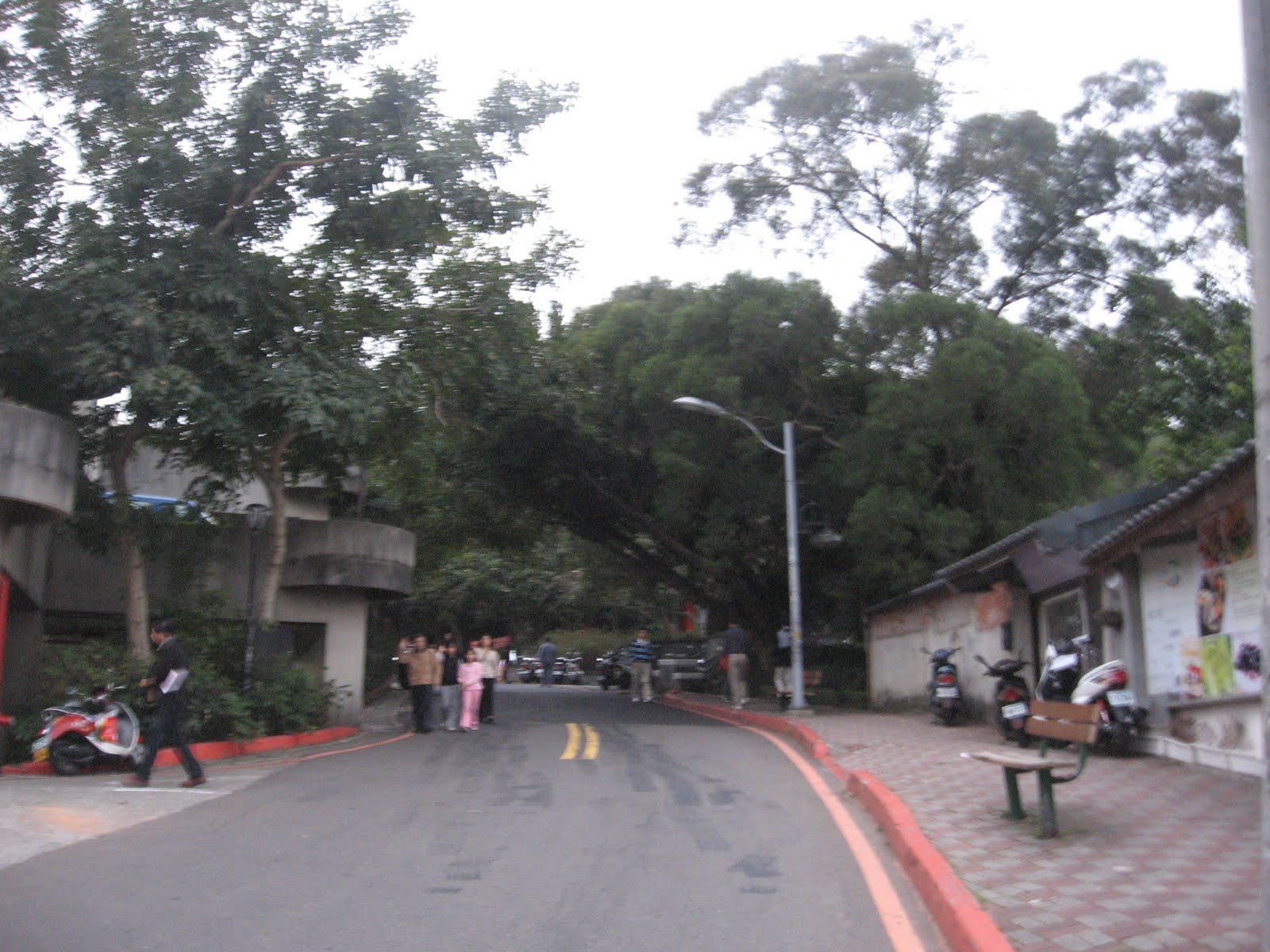


 Got some exercise by walking to what might be called the "top of Hsin Chu" yesterday and again today.
Saw that many people from the city were doing the walk to the top. Was very pleasant, with pretty scenery. Even was able to do pull ups, with bars all over. I did eight yesterday, but only six today.
There was even a guy cutting hair up here. People pushed parents in wheel chairs all the way up. I learned how to say "Do you speak Mandarin?" in Fukenese ("Taiwanese") from one of the sons who brought his Mom up (not everyone of that generation knows Mandarin, but most people do now. When I was here before, people spoke a lot more Fukenese.
[Sorry: I do not know how to put these pictures in the right order, so will figure that out next time]
Even was able to get a bunch of baojaos (plantain?) and a baked sweet potato on the walk down the mountain and home.
Thursday, December 9, 2010
In Front? Way over there? The far front?
Today I found out just how different "in front" is in English from the Chinese "qian mian" ("前面“)。In English, "in front" means close to the speaker... but in Chinese, it means the direction you are facing. But I learned when going to swim laps at the pool, that the lanes "in front" actually meant the far lanes. In English, the lanes in front would have meant the close lanes, closer to, well, right in front of me.
Different perspective!
Sunday, December 5, 2010
Returned to Astronomy by Going to Taiwan
I have returned to research as an affiliated astronomer! I resume my blog about my experiences getting back in, of going to live in another country, and of being newly married yet having to live apart from a lovingly patient new wife. I write about seeking career and family.
I am grateful to some wonderful people and an extremely pleasant institution in Taiwan for hiring me to to astronomy in this successful pleasant comfortable country that I grew to love when I was able to live in Taiwan for two years while younger. I am grateful to be hired without having published papers because not being given credit or participation after the "personal incident" that the Director of the global telescope forced on me. I use his label, "personal incident", for the events that he did not let me report, and for the events that were so ruinous for my career. A personally funded institution means no recourse for its members when it is the funder who gets personal when it is unwelcome. This blog is to chronicle overcoming this incident, not just for my career but also to have family. Career disruptions distort the process of seeking family given the oft-ignored fact of how nature does not allow for arbitrary delay of family. While working I had been clear of my intentions that my priority outside of work was to date as part of seeking marriage, with some urgency to do so at an age when we could have children. What this meant to me was how I didn't want to feel like if I should seek someone much younger, because such a consideration could mean passing up someone wonderful. It did turn out just this way, that I did meet an ideal someone that I wanted to grow old with. To give nature a chance to have children meant not delaying marriage. But the dominoes from the global telescope forced us to wait another year to be married. Now we are married, after the wonderful event in 2010 July. It is not good that we have had to live apart, though through sacrifice we manage to see each other monthly. It is hard writing about this personal priority, but it is essential to display what happens in science careers if science is going to change. I am grateful to a group of astronomers that unknownst to me submitted a contribution to the US decadal report on astronomy seriously challenging the astronomy profession's family unfriendly nature. So I write to document the result of seeking to have children along with my seeking to be in astronomy.
I also chronicle the experience of going to live in another country with different culture and language. My experience in Taiwan is more unusual given how I have worked strenuously at learning Mandarin Chinese as a hobby, and so come here with more than the usual ability to communicate. It is truly wonderful to be able to dive in and go anywhere without worrying too much about finding someone who speaks English (like in Italy or Thailand). There are still huge limitations with using another language, mostly given how in any new situation in which you don't know the vocabulary you suddenly become unable to communicate. It brings many unexpected results, most good, but I have had the occasional person wrongly take me to understand everything. There have been a few instances when I actually needed to be "babied" as a foreigner but wasn't given that chance because "he speaks Chinese." But the people of Taiwan are wonderfully generous, tolerant, and patient, and with only rare exception are delightfully eager to help.
My return to astronomy has been accomplished by starting a completely new project on "planet destruction." I have my first paper submitted and posted: I have gotten good attention for how "aborted" planet destruction, with planets migrating back away from the brink of Roche lobe overflow demise, may explain the pattern of a short period "pile up" that we see in planets being found today.
Tuesday, November 2, 2010
Hate it when the floor breaks under your feet!
Sufficiently uninteresting post to move from the top, but still interesting enough to keep. It's just out of context. But it was still strange to have the floor pop out from under me.
This posting from 12/17/10 has been moved to fit in at 11/01/10 because I don't want it to be on the top.
Hate it when the floor breaks under your feet!
Especially in your own home!
--
Was just sitting on the couch and the floor starts making all this noise under my feet! All this cracking and breaking. Felt like things were moving! I've been hearing sounds like there was someone in my apartment dropping things for weeks, but I don't believe in ghosts. The weather today is beautiful, and it's been a few weeks since the little earthquake, so I didn't know what was up. Could there be people or animals under the floor?The cracking and breaking gets so loud I unlock the door and run out into the hall. POP! goes the floor, and with a big puff of dust the floor tiles came up. Made me think the floor was going to cave in. I suppose it's just that the floor tiles were put in too tight, but I was left with a upside-down V-shaped floor. After calling around to be sure I was safe, I am back inside, but hate to walk on it. I had to a little, and some tiles fell back down a cm or so. Now the ground doesn't feel solid below my feet!
Sometime I need to add the pictures of the floor.
It felt pretty scary.


Subscribe to:
Posts (Atom)